0%

Buying wholesale eyewear frames can feel simple until the samples arrive. A frame may look elegant online, yet feel heavy, stiff, or poorly balanced in your hands. Small details matter. Hinge movement, acetate polish, bridge comfort, lens shape, and finish quality can influence customer satisfaction and repeat sales.

Michele Aracri, CEO of De Rigo, has said, “A successful eyewear collection must combine design, quality, and accessibility.” That principle remains useful when choosing wholesale eyewear frames. Low prices alone do not create a profitable collection. Retailers must also consider durability, fit diversity, color selection, packaging, and dependable supplier communication.

This guide presents ten practical tips for evaluating wholesale eyewear frames with greater confidence. It explores how to compare materials, inspect samples, assess size ranges, and identify styles with realistic selling potential. It also considers minimum order quantities, lead times, private labeling, and quality-control procedures. These details can protect your budget and reduce avoidable inventory problems.

Still, no buying method is perfect. A popular color can suddenly slow down. A promising shape may suit fewer faces than expected. Personal taste can mislead even experienced buyers. That is why careful testing matters.

Touch the frames.

Check the hinges.

Ask difficult questions.

A reliable purchasing decision combines market knowledge with direct product experience. The following tips will help buyers build a more balanced, practical, and commercially responsible eyewear selection.
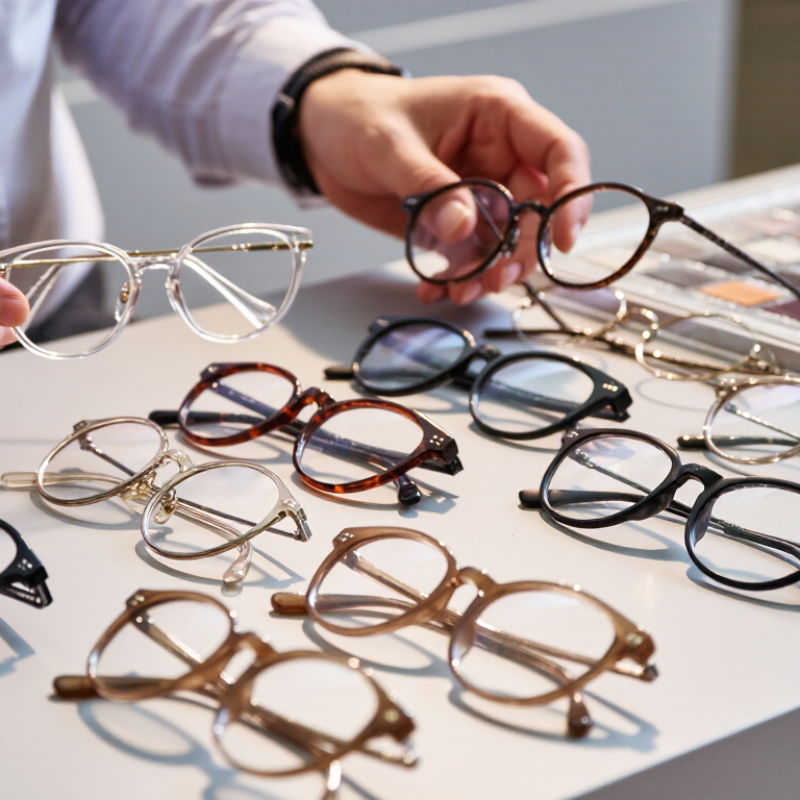
10 Tips for Buying Wholesale Eyewear Frames?

Define Your Wholesale Eyewear Needs and Target Customers

10 Tips for Buying Wholesale Eyewear Frames

Define Your Wholesale Eyewear Needs and Target Customers

A clear customer profile should guide every wholesale eyewear decision. Identify age, lifestyle, income level, face shapes, and typical prescription needs. A university customer may prefer lightweight acetate frames, bright colors, and affordable prices. Office workers may choose thinner profiles, neutral tones, and durable hinges.

Study your current sales data before contacting suppliers. Check which frame sizes sell quickly and which remain in storage. Record bridge width, temple length, materials, colors, and price points. These details reveal real demand better than personal taste. Do not order only what looks attractive in a catalog.

Start with a balanced assortment. Include small, medium, and large fits, plus several adjustable nose designs. Consider customers with narrow bridges or wider faces. Sample frames before placing a large order. Inspect hinge movement, surface finishing, alignment, and frame flexibility under normal handling.

Small details matter.

Set a budget for testing, not just inventory. A lower unit price can create losses if the style fits poorly or receives weak customer interest. I have seen buyers overvalue unusual colors and underestimate everyday black, brown, and clear options. That mistake is easy to repeat.

Leave room to improve. Review customer comments after each purchase, even when the feedback feels inconvenient. Reliable records help refine future orders, reduce waste, and build a collection that serves actual customers rather than imagined demand.

Define Your Wholesale Eyewear Needs and Target Customers

Use the population mix as an initial guide when planning wholesale frame quantities: adult customers represent the largest combined opportunity, while children and older adults may require dedicated sizing, fit, and comfort options. These figures are rounded from the U.S. Census Bureau’s 2020 Census and should be validated against your local customer and sales data.

Set a Realistic Budget for Frames and Inventory

Set a realistic budget before you compare wholesale eyewear frames. Start with cash you can safely use after rent, payroll, software, and daily operating costs. Separate frame costs from freight, taxes, packaging, inspection, and payment fees. The invoice is only one part of the investment. Keep a written landed-cost estimate for every style. It prevents attractive prices from distorting your decision. Keep it simple.

Allocate funds across a planned assortment instead of buying deeply into one shape. Reserve money for optical frames, sunwear, different sizes, and several color options. Ask suppliers about minimum order quantities, sample charges, replacement policies, and production timelines. Order samples before committing to a larger run. Check hinge movement, surface finishing, alignment, and package protection under normal handling. Small defects can become expensive when repeated across hundreds of units. Quality checks take time, but rushed savings often disappear later.

Protect cash flow with a contingency reserve of about 10 to 15 percent. Adjust it for your market and shipping risks. Review expected sell-through every month, not only during seasonal changes. If a style moves slowly, pause reorders and reduce its display space. I have seen buyers value a low unit price while underestimating storage and markdown pressure. That is an easy mistake to repeat. Leave room to learn. A budget should guide decisions, not force every dollar into inventory. Record actual costs after delivery and revise the next purchase plan.

Evaluate Frame Materials, Designs, Sizes, and Quality

10 Tips for Buying Wholesale Eyewear Frames

Evaluate the material before discussing price. Acetate usually feels warmer and offers attractive color depth. Stainless steel can provide strength with a lighter profile. Check the hinges, bridge, and temple joints by opening each frame repeatedly. Look for clean edges, even polishing, and screws that do not wobble. Small defects often become expensive returns.

Study the design range against your customers’ needs. Include classic shapes, modern angles, and adjustable nose features. Measure lens width, bridge width, and temple length accurately. A frame that looks excellent may still fit poorly. Ask for size charts and physical samples before placing a large order. Samples matter.

Inspect optical quality and production consistency across several pieces. Compare color, alignment, surface finish, and logo-free packaging details. Request material information and quality-control records when available. Confirm whether replacement parts can be supplied. I once underestimated color variation between batches; the display looked uneven. That mistake changed my inspection process. Do not rely on photographs alone. Photograph every approved sample and record its measurements. A dependable supplier should answer clearly, not defensively. Your final choice should balance durability, comfort, design appeal, and realistic wholesale costs.

10 Tips for Buying Wholesale Eyewear Frames? - Evaluate Frame Materials, Designs, Sizes, and Quality

No. Evaluation Area What to Check Useful Facts and Typical Specifications Wholesale Buying Tip Quality Warning Signs
1 Frame Material Compare acetate, injected plastic, stainless steel, aluminum, and titanium according to the target price and customer use. Acetate is a plant-based plastic known for color depth and polishability. Stainless steel is relatively strong and corrosion-resistant. Titanium is lightweight, highly corrosion-resistant, and generally more expensive. Request the exact material composition and separate pricing for each material category before comparing quotations. Unclear material descriptions, strong chemical odors, brittle temples, or plating that flakes during light handling.
2 Frame Design Review full-rim, semi-rimless, rimless, round, rectangular, cat-eye, and geometric styles. Full-rim frames provide the most lens-edge support. Rimless and semi-rimless designs usually require more precise lens drilling or groove work. Build a balanced assortment: core everyday shapes plus a smaller share of seasonal or fashion-oriented designs. Uneven rims, mismatched left and right fronts, loose decorative parts, or sharp unfinished edges.
3 Frame Size Check eye size, bridge width, temple length, and the complete frame width. A common optical size format is written as three numbers, such as 52-18-140: 52 mm eye size, 18 mm bridge, and 140 mm temple length. Actual fit varies with shape and construction. Ask for a dimension chart and physical samples. Do not rely only on product photos or nominal size labels such as small, medium, or large. Missing measurements, inconsistent dimensions within the same model, or temples that do not align when folded.
4 Hinge Construction Inspect barrel hinges, spring hinges, hinge screws, and the connection between the front and temples. Spring hinges allow additional outward movement but add components that may require tighter assembly control. Conventional hinges are simpler and can be easier to service. Open and close samples repeatedly, then check whether both temples have similar resistance and return to a level position. Grinding noises, excessive looseness, uneven tension, protruding screws, or hinge joints that bind.
5 Bridge and Nose Fit Evaluate bridge width, bridge shape, nose-pad position, and contact comfort. Adjustable nose pads can improve fit across different nose shapes. An integrated bridge may offer a cleaner appearance but provides less adjustment than separate nose pads. Stock multiple bridge options and verify that nose pads are securely mounted and made from suitable skin-contact materials. Pads that rotate freely, exposed metal edges, uneven pad arms, or a bridge that causes visible frame distortion.
6 Lens Compatibility Confirm the frame can accommodate the intended lens materials, prescriptions, thicknesses, and rim type. Lens groove depth and shape affect edging and retention. High-prescription lenses may require suitable eye sizes, bevel placement, and adequate rim support. Request technical drawings or lens-groove information for rimless, semi-rimless, and unusually shaped frames. Shallow or irregular grooves, inconsistent rim thickness, lens movement in samples, or frames that warp during fitting.
7 Surface Finish Inspect polishing, coloring, printing, plating, coating uniformity, and edge finishing under bright light. Quality finishes should be visually uniform and free from visible pits, bubbles, runs, stains, or color differences between matching parts. Approve a reference sample and define acceptable color variation, scratches, and surface defects in the purchase specification. Peeling color, rough edges, cloudy transparent areas, polishing marks, or decoration that is misaligned.
8 Structural Alignment Check front curvature, temple alignment, balance, symmetry, and whether the frame rests evenly on a flat surface. Both temples should generally align when folded, and the front should not show obvious twisting. Minor adjustments may be possible, but severe distortion indicates a production problem. Inspect samples from different cartons or production batches rather than approving only one hand-selected sample. Rocking on a flat surface, uneven temple tips, twisted fronts, asymmetrical end pieces, or frequent adjustment requirements.
9 Comfort and Durability Assess weight distribution, temple pressure, flexibility, repeated opening and closing, and resistance to normal handling. A lightweight frame is not automatically durable. Durability depends on material, cross-section, hinge design, joining quality, and finishing. Use a documented sample test, record defects, and agree on an inspection method before placing a large order. Cracking around hinges, whitening at stressed areas, loose components, sharp contact points, or excessive frame flex.
10 Compliance, Packaging, and Order Terms Confirm labeling, material declarations, packaging, minimum order quantity, lead time, replacement policy, and inspection requirements. Requirements vary by destination and product category. Packaging should protect frames from scratches, deformation, moisture, and impact during transport. Put specifications, tolerances, carton quantities, delivery terms, and defect-handling procedures in writing before payment. Missing product information, weak packaging, undocumented substitutions, unclear defect allowances, or inconsistent carton counts.

Note: Frame dimensions, material performance, and regulatory obligations can vary by model, manufacturing process, and destination market. Always verify specifications with physical samples and applicable local requirements.

Verify Suppliers, Minimum Orders, Samples, and Certifications

10 Tips for Buying Wholesale Eyewear Frames?

Wholesale buyers should verify suppliers before discussing price. Request a current business license, factory address, production photos, and two trade references. Check whether the legal company name matches the bank and invoice details. Grand View Research estimated the global eyewear market at about USD 115.95 billion in 2022, with strong growth expected through 2030. A crowded market increases the risk of rushed claims. Ask direct questions.

Minimum order quantities need careful review. A low MOQ may hide higher unit prices, mold fees, or mixed-color restrictions. Request a written quotation showing frame price, packaging, tooling, shipping terms, and replacement policy. Order samples from the same production line, not only showroom pieces. Inspect hinge alignment, temple flexibility, surface coating, logo placement, and screw tightness. Keep a signed reference sample. I once trusted photos too much. That was careless.

Certifications should be traceable. Ask for the certificate number, issuing body, scope, factory address, and expiry date. For frame safety, request relevant test evidence, such as ISO 12870 compliance where applicable. For sunglasses, confirm testing against the destination market’s requirements, including UV performance. The European Commission’s Safety Gate reports regularly show that documentation failures can lead to product recalls. Do not accept a PDF without verification. Contact the issuer directly. Samples can still fail. Test several pieces from different cartons, and record defects with clear photos before approving bulk production.

Compare Prices, Shipping Terms, and After-Sales Support

When buying wholesale eyewear frames, the lowest unit price can be misleading. A frame priced at $2.40 may become $3.10 after packaging, handling, and delivery charges. Request a detailed quotation before comparing suppliers. Check material, hinge type, lens dimensions, color options, and minimum order quantity. Small differences matter across 500 pieces.

Shipping terms deserve equal attention. Ask whether the quote includes export handling, insurance, customs duties, and final delivery. Confirm the dispatch location and estimated transit time in writing. A cheaper freight option may take three extra weeks. That delay can leave display trays empty. Request carton dimensions, package weight, and tracking procedures. I once focused only on the freight total and missed a residential delivery surcharge. It was an avoidable mistake.

After-sales support often reveals a supplier’s reliability. Ask how defective frames are reported, how many days you have for inspection, and whether replacements or credits are available. Keep sample photos, order numbers, and inspection records. A clear process is more useful than a friendly promise. Check how quickly questions receive practical answers. Slow replies before payment may become slower after delivery. Still, no supplier handles every issue perfectly. Build a small allowance for defects, test samples before bulk ordering, and review the agreement carefully. Your comparison should measure total cost, delivery risk, and support quality—not price alone.

FAQS

How should I set a budget for wholesale eyewear frames?

Use cash remaining after rent, payroll, software, and daily operating costs. Separate frame prices from freight, taxes, packaging, inspection, and payment fees. Keep it simple.

What costs should I include in the final estimate?

Include the frame price, delivery charges, duties, packaging, insurance, and payment fees. A frame priced at $2.40 may reach $3.10 after added costs. Record the landed cost for every style.

How should I divide money across my inventory?

Spread funds across optical frames, sunwear, sizes, shapes, and colors. Avoid buying deeply into one style. Empty trays and slow sellers both create pressure.

Should I order samples before placing a large order?

Yes, order samples first. Check hinge movement, surface finishing, alignment, lens dimensions, and package protection. Handle them like normal stock. Small defects spread.

How much money should I reserve for unexpected problems?

Keep about 10 to 15 percent as a contingency reserve. Adjust it for shipping delays, defects, and market uncertainty. The exact percentage may need revision.

What should I ask for in a detailed quotation?

Ask about materials, hinge types, colors, sizes, minimum quantities, and sample charges. Confirm handling, insurance, duties, and final delivery. Do not compare unit prices alone.

How can shipping terms affect my inventory plan?

Confirm the dispatch location and transit time in writing. Request carton dimensions, package weight, and tracking details. A cheaper option may take three extra weeks. Delays hurt.

What should I check about after-sales support?

Ask how defects are reported, how long inspections remain open, and whether replacements or credits are available. Save photos, order numbers, and inspection records. Friendly promises are not enough.

How often should I review inventory performance?

Review expected sell-through every month. Pause reorders when a style moves slowly, and reduce its display space. I may overvalue a low price sometimes. Storage and markdown costs still matter.

Conclusion

Buying wholesale eyewear frames requires careful planning rather than choosing products based on appearance alone. Start by defining your target customers, preferred styles, price points, and expected sales volume. Set a realistic budget that covers frames, samples, shipping, storage, and possible replacement costs. When comparing products, examine materials, construction, hinge quality, lens compatibility, sizes, colors, and overall comfort to ensure the frames match your customers’ needs.

Before placing a large order, research each supplier’s reliability, communication, production capabilities, minimum order requirements, and sample policy. Request relevant certifications or product documentation when appropriate, and inspect samples for consistency and durability. Finally, compare total costs instead of focusing only on unit prices, taking shipping terms, payment conditions, delivery times, return policies, and after-sales support into account. A thoughtful evaluation of these factors can help you reduce purchasing risks, maintain consistent quality, and build a practical inventory of wholesale eyewear frames.

Amelia

Amelia

Amelia is a dedicated marketing professional with a deep understanding of the company’s products, customers, and evolving market needs. With a strong background in brand communication, content strategy, and digital marketing, she transforms complex product information into clear, practical, and......